 |
|||||||||||||||||||||
|
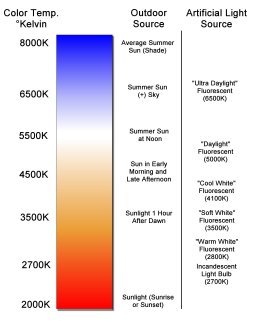
The term "Color Temperature" describes the color of light emitted by a particular light source. Each form of artificial light, whether incandescent, fluorescent, or light emitting diode (LED) has its own color temperature (measured in degrees Kelvin, or "K"). While incandescent light is a "true" value, other forms of artificial light are expressed as correlated color temperature (CCT) because it is an approximate value. Lights with lower color temperatures (2700K to 3500K) emit a "warm" reddish-orange color of light that brings out the red and orange tones in objects viewed. Lamps that have a CCT range from 4000K to 4500K tend make objects viewed under that color of light appear yellowish-green. Higher color temperature lamps in the 5000K to 5500K range approximates summer sunlight, giving viewed objects a more accurate color rendering, similar to matching colors under natural outdoor sunlight. |
|||||||||||||||||||||
 |
|||||||||||||||||||||
|
Click HERE to enlarge this image |
|||||||||||||||||||||
|
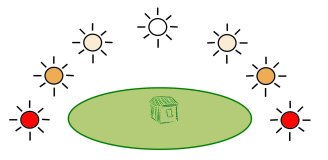
The color temperature of sunlight changes dramatically during the course of the day. As seen in the illustration (below), at sunrise and sunset, the color temperature of the sun is at 2000K. An hour later, the color temperature climbs up to 3500K. By noon, in the summertime, on a clear day, the color temperature has risen to 5500K. For accurate color comparisons, it is better to use the color of light produced by the noon-day sun than that at dawn. Color comparisons using the light produced at dawn would be like trying to match colors while wearing red or orange sunglasses. That is why it is so important to provide your eyes with the most color-neutral lighting source possible. |
|||||||||||||||||||||
 |
|||||||||||||||||||||
|
Click HERE to enlarge this image
|
|||||||||||||||||||||
|
Color Rendering Index (CRI) refers to how accurately a color is perceived at a given color temperature of light. Think of the CRI value as a percentage. Sunlight, by definition, has a CRI value of 100, because it is the standard; it is perfect. If an artificial light source, say an incandescent light bulb, has a color temperature of 2800K, and a CRI of 100, then that means that any colored object viewed in that orange/red light source will be viewed as accurately as it can... under an orange-red light source!
Remember, if you want to accurately match colors, or if you just want the most natural, color-balanced light available, you must choose a light source that has a color temperature that is in the 5000K - 5500K range (sunlight at around noon), with a CRI of at least 90. |
|||||||||||||||||||||
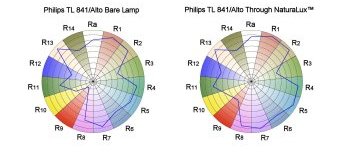
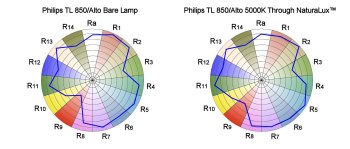
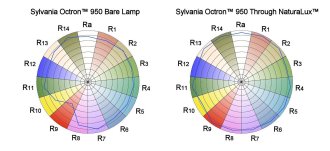
| In the examples below, we have created a graph for three common fluorescent light bulbs types (left to right; 4100K triphosphor; 5000K triphosphor and 5000K halophosphor.) Each graph includes the various individual colors that make up white light (Ra). The closer the graph line is to the outer edge of the circle, the greater the color accuracy is for that color temperature light source. You will see in each case, once the unfiltered light source is then filtered through the NaturaLux™ Filter, the color rendering improves to give you a color-corrected, color balanced light source. | |||||||||||||||||||||
 |
 |
 |
|||||||||||||||||||
|
Click HERE to Enlarge
|
Click HERE to Enlarge | Click HERE to Enlarge | |||||||||||||||||||
 |
|||||||||||||||||||||
|
Click HERE to enlarge this image
|
|||||||||||||||||||||
|
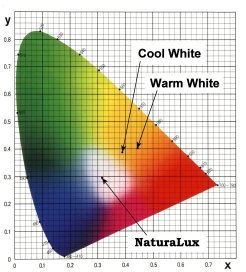
Chromaticity Values (or Lighted Appearance Values) as seen in the graphic (below) involves both an x and a y value. The closer the intersection of the x & y values are to the center of the white portion of the locus, the more accurate color rendering will be. Notice where the cool white (4100K) and the warm white (3500K) x, y coordinates lie within the black body locus? Conversely, a 5000K lamp, filtered by the NaturaLux™ Filter places the light in the central white portion of the black body locus. |
|||||||||||||||||||||
 |
|||||||||||||||||||||
|
Click HERE to enlarge this image
|
|||||||||||||||||||||
|
FULL SPECTRUM LIGHT
|
|||||||||||||||||||||
