|
|||
|
Over a decade ago, a team of research scientists at the Lawrence Berkeley National Laboratory (LBNL), headed by Dr. Sam Berman, Ph.D., scientifically showed that light enhanced in the blue-green portion of visible light is superior to regular white light for perceived brightness. Today, the United States Dept. of Energy has embraced this technology as being a key factor in saving energy by increasing the color temperature to be more heavily weighted in the blue-green spectra of visible light.
Enhancing the blue-green spectrum of light was originally referred to as scotopic enhancement, but today it is being called spectrally enhanced lighting (SEL). Visual performance is generally improved with a smaller pupil size. This is even true for light levels typical of building interiors. This understanding led the LBNL team to propose that reducing pupil size via shifting lamp color of light toward higher scotopic (blue-green) content could compensate for any reduction in visual performance caused by reducing light levels. Reduced light levels lead to substantial energy savings without compromising visual performance.
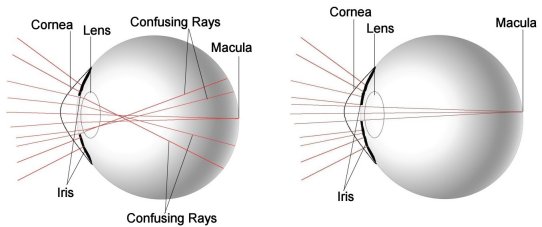
As you can see in the two drawings above, the drawing on the left shows some light rays are absorbed by the iris, which lies in front of the lens. The rays that pass through the lens are scattered along the retinal surface. The rays of light that land on the macula become focusable, while all other rays remain blurred or become peripheral images (confusing rays). The drawing on the right demonstrates how the iris eliminates the confusing rays of light. When the pupil is smaller, the iris absorbs more of the light. This action allows less confusing light rays back to the retinal surface. When the pupil is smaller, the depth of field increases and visual acuity improves. This occurs even though the total amount of illumination received by the retina has decreased. Typically, lighting manufacturers, lighting engineers and lighting designers have utilized photopic (daylight) light meters to determine light output that are calibrated to the eye's sensitivity using only cone function in the central part of the retina, the fovea. Photopic light meters blatantly disregard the scotopic effect (night vision, peripheral vision) have on vision. Lighting professionals have accepted this photopic light measurement over the years because it was incorrectly assumed that the more light-sensitive rods exclusively functioned at very low light levels. That explains why lighting environments that use warm white (3000K-3500K) and even cool white (4100K) fluorescent lighting appear dimmer than the same environment lit by lamps that have a color temperature of 5000K or higher. A growing number of studies are showing that general lighting with higher scotopic/photopic (S/P) ratios (higher color temperature) provide improved visual acuity. This, in turn, results in reduced visual fatigue, faster reading times, and less glare. As we learned earlier, glare leads to headaches and eyestrain. Scotopically enhanced lighting also provides the side benefits of reducing tasking errors, as well as improving performance and increasing productivity. The U.S. Department of Energy, on its website, lists numerous publications on the subject of scotopic enhancement. The D.O.E. now refers to scotopic enhancement as "Spectrally Enhanced Lighting" or SEL for short. Regardless of what this technology is called, we now have an inexpensive way to save energy without compromising our visual needs. The D.O.E. has 10 different studies on their site that show that by installing a higher Kelvin temperature (>5000K) lighting system can save 19% - 46% in energy costs. That is HUGE!!! In 2002, a feasibility study was conducted by the DOE and others to evaluate user acceptance of SEL strategies in an office environment and the results were published by DOE in 2004. The study was conducted on two almost identical floors of a building, each floor consisting of about 30,000 sq. ft. One floor utilized 3500K lamps (reference) and the other floor had 5000K lamps installed. Both lamps had a CRI value of 86. In their feasibility studies, the DOE concluded the following:
See for yourself: Scotopically Enhanced Lighting Studies and Articles Spectrally Enhanced Lighting: Related Publications Spectrally Enhanced Lighting--Field Evaluation Reveals Significant Energy Saving Implementing New and Emerging Lighting Technologies (starting on page 37) Spectrally Enhanced Lighting: Sonoma State University Spectrally Enhanced Lighting: San Jose State University U.S. Department of Energy: Spectrally Enhanced Lighting 2013 DOE SSL R & D Workshop Spectrally Enhanced Lighting by Brian Liebel, PE, LC, 2007 Task Ambient Lighting by Stan Walerczyk, HCLP, CLEP, LC, 2013
Once you examine the studies and articles dating from 1954 to 2013, you will see the evolution of lighting as we know it. Using the NaturaLux™ Filter, your ordinary lighting will become UV-Safe, Color Enhanced, Spectrally Enhanced, Glare-Reduced... EXTRAORDINARY LIGHTING!
Which room appears brighter? Here's a hint: look at the ceiling tiles... Please take the time to read Dr. Sam Berman's report that was presented at the 1991 IESNA Annual Conference entitled: "Energy Efficiency Consequences of Scotopic Sensitivity." The report explains the energy saving aspects and cost efficiency of scotopically enhanced lighting. |
|||